
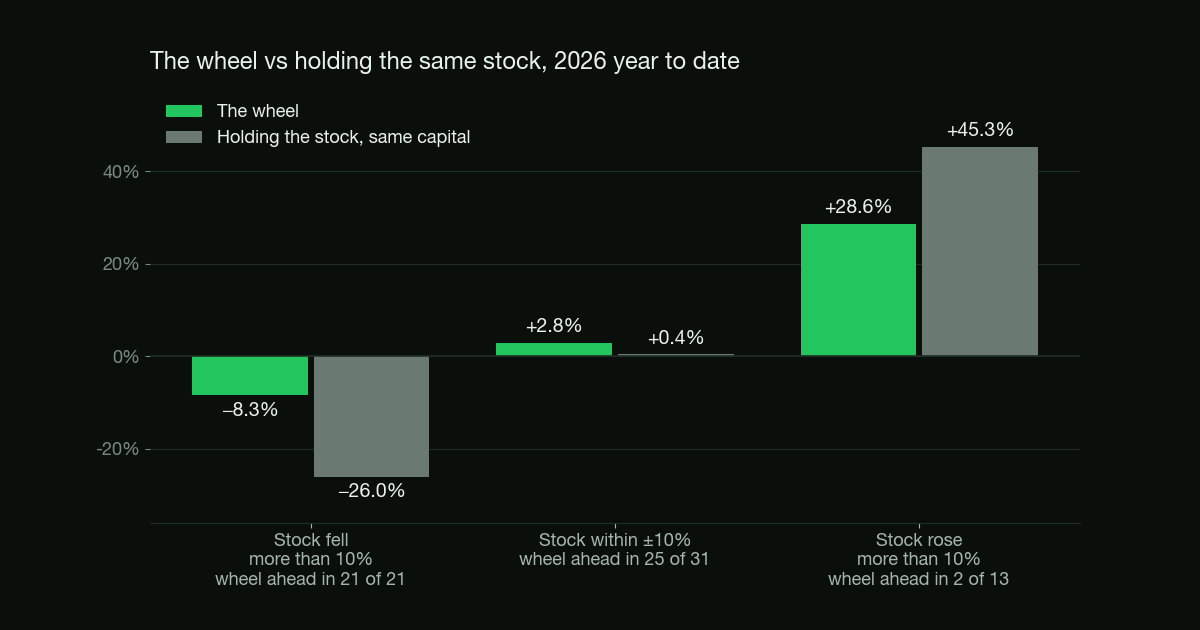
 Every stock our connected account wheeled in 2026, grouped by how the stock moved; figures from OptionAgent's Wheel vs Stock page.
When there's a stock I'd like to own, I rarely place a limit order for it. I wheel it: I sell a put at the price I'd be happy to pay, take the shares if the put is assigned, and sell covered calls on them until they're called away. Then I start over.
We built a page in OptionAgent that puts every wheel next to the plain alternative: buying the same stock with the same money, on the same day, and holding it. Every chart and screenshot in this post comes from the OptionAgent software, for our own brokerage account connected to OptionAgent: the results from that page, the Wheel vs Stock page, and the last two screenshots from its Getting started page. The screenshots are taken in the app's privacy mode, so dollar amounts are hidden and only percentages show. Looking at a full year of our own wheel trades this way made one thing very clear. The wheel is a defensive strategy. It cushions falling stocks, earns while a stock goes nowhere, and only falls behind when a stock rallies hard. Even then it is mostly trading return now for return later.
A sold put is a limit order that pays you while you wait
Compare the two ways of buying a stock at, say, $100:
- A limit order at $100. If the stock never gets there, nothing happens and you earn nothing. If it does, you own it at $100.
- A put sold at the $100 strike. If the stock stays above $100, the put expires or is bought back cheaply and you keep the premium, then sell another one. If the stock falls through $100, you're assigned and own it at $100 minus the premium you already collected.
This year, every put we had assigned bought the stock below its strike, between 0.5% and 3.4% lower (1.9% at the median). Most of our puts were never assigned at all, and each of those still paid its premium: money a limit order would never have made.
When the stock falls, the wheel loses much less
In every stock we wheeled this year that fell more than 10%, the wheel did better than holding the stock: 21 out of 21. Together, the wheel lost 8.3% where the stock lost 26%.
APP is the clearest example. We sold a put at the 480 strike in early January, with APP at $618. APP fell through it, and we were assigned at an effective $467.70 a share after the premium, about a quarter below the January price. From then on we sold covered calls on the shares, through APP's spring rally and its slide since. The wheel can't make a falling stock go up: we're down 21%. But a buyer on that January day is down 58%.
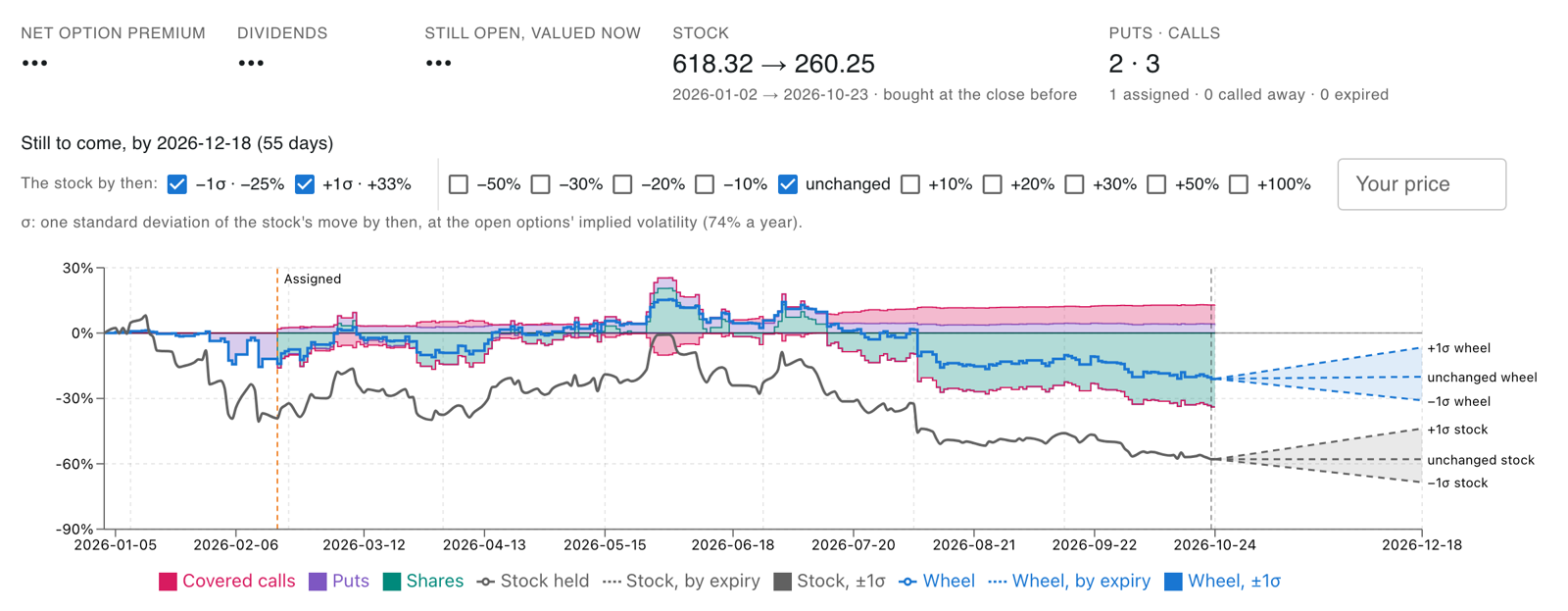 APP on OptionAgent's Wheel vs Stock page, for our connected brokerage account (privacy mode).
The shaded areas split the wheel into its parts: the shares (green) carry the loss, while the puts (purple) and covered calls (pink) keep adding premium on top.
When the stock goes sideways, the wheel earns while the stock doesn't
Most stocks spend most of their time in a range. In the stocks that ended the year within 10% of where we started, the wheel came out ahead in 25 of 31.
COF shows what that looks like. Our puts were assigned in March at $192.10 a share, below where COF traded in January, and we've sold covered calls on the shares since, each bought back for a fraction of what it brought in. COF is down about 6% from when we started; the wheel is up 8.7%, close to 12% a year. In a range, the stock earns nothing and every put and call sold is income.
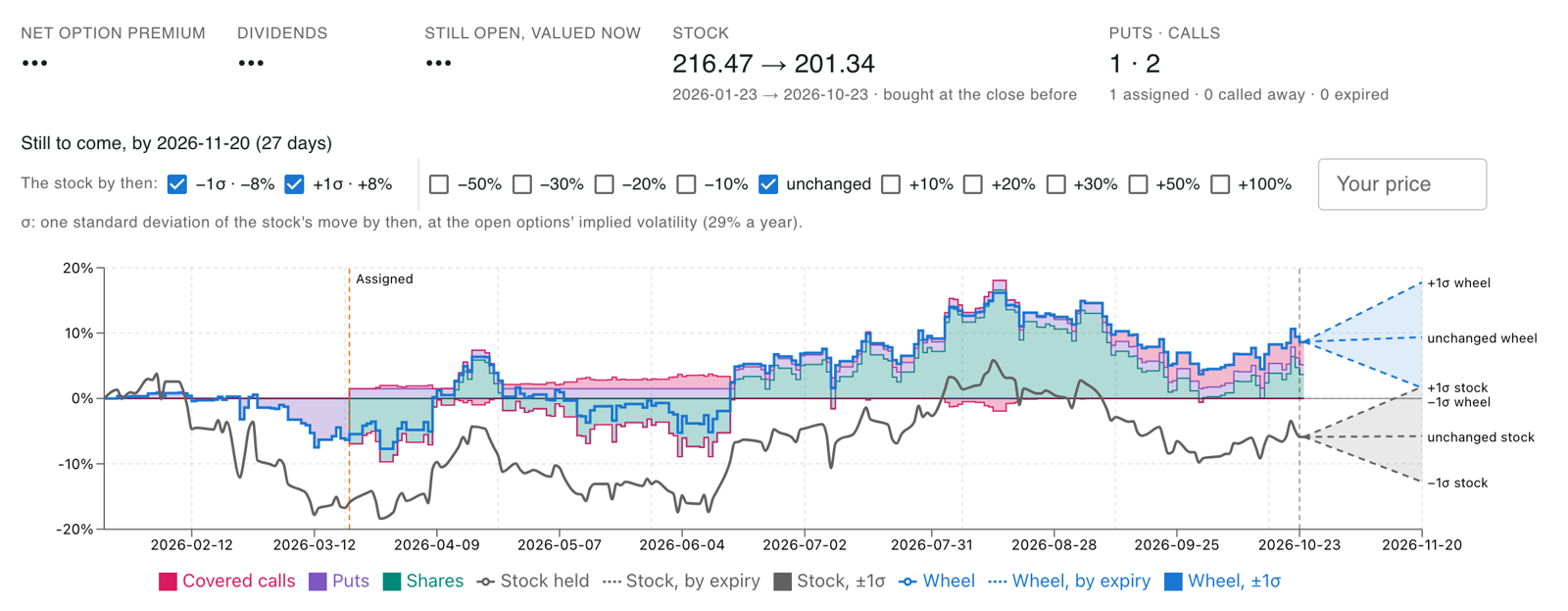 COF on OptionAgent's Wheel vs Stock page, for our connected brokerage account (privacy mode).
The same holds for a stock that drifts up slowly: the premiums keep pace, and the calls get rolled up with the price.
When the stock rallies hard, the stock wins — for now
Covered calls cap the gain. When a stock runs through the call's strike, you either let the shares go or buy the call back and sell a later, higher one: a roll. In the stocks that rose more than 10% this year, holding the stock was ahead in 11 of 13.
MU more than doubled while we wheeled it. Each time it ran through a call, we rolled up and out: from the 500 strike in the spring all the way to a 1700 call that expires in December 2028. Today the wheel is up 74% against the stock's 112%.
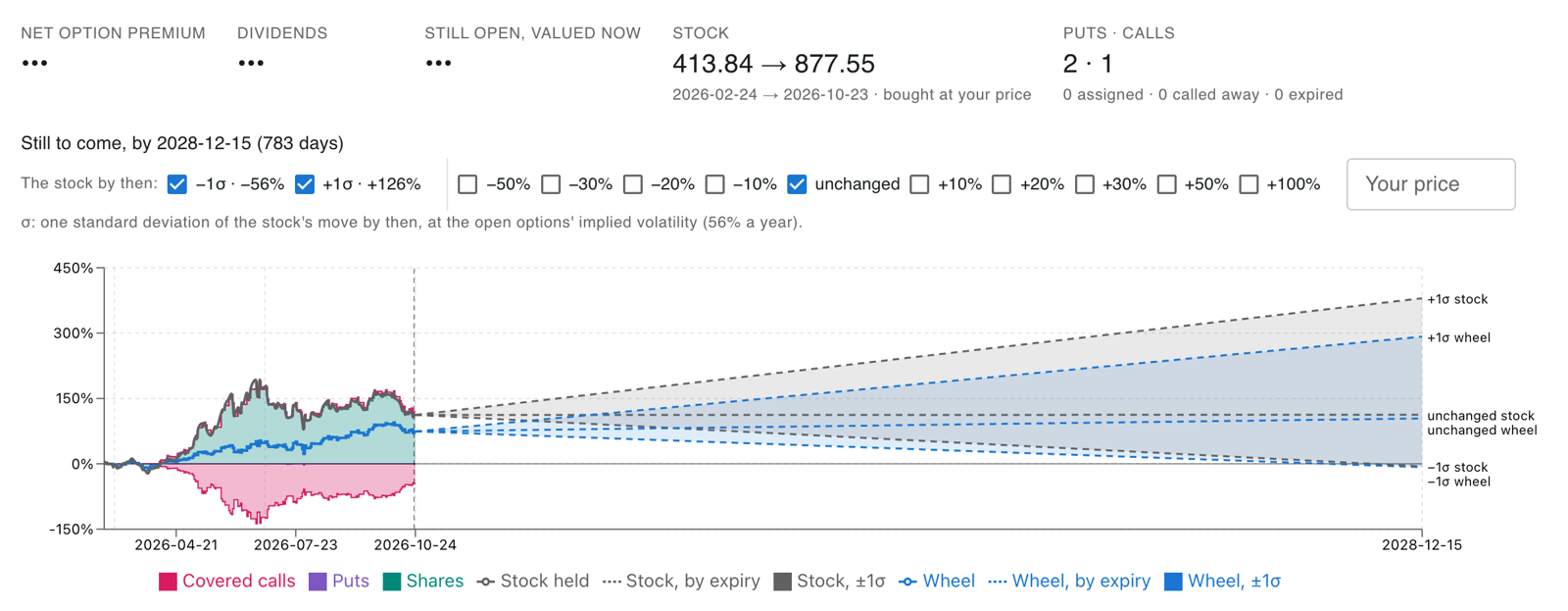 MU on OptionAgent's Wheel vs Stock page, for our connected brokerage account (privacy mode): the dotted lines and shaded bands run to the call's expiration.
That gap isn't the whole story. The 1700 call is far above MU's price, so everything it's marked at is time value. If MU simply stays where it is until December 2028, that call expires worthless and its value comes back to us. The wheel then ends at 104% against the stock's 112.5%. Each roll bought back a call at a loss and sold a later one whose extra time value pays the loss back if the stock stops running. We traded return now for return over time, and moved our cap from 500 to 1700 along the way.
SNOW tells the same story more strongly. Its covered calls were rolled out to December 2028 too. The wheel trails the stock by 8 points today, but if SNOW stays where it is, the wheel finishes 37 points ahead.
Puts that never get assigned still pay
PLTR rose this year, and our puts were always below its price. We sold them week after week at strikes from 107 to 155, and none was ever assigned. A limit order at those prices would have filled once at most and earned nothing the rest of the time. The puts kept every premium. Measured on the capital they tied up on average, they made 41% while the stock made 17%. At their busiest they needed about four times that average as collateral, and even on that peak they made about 10%.
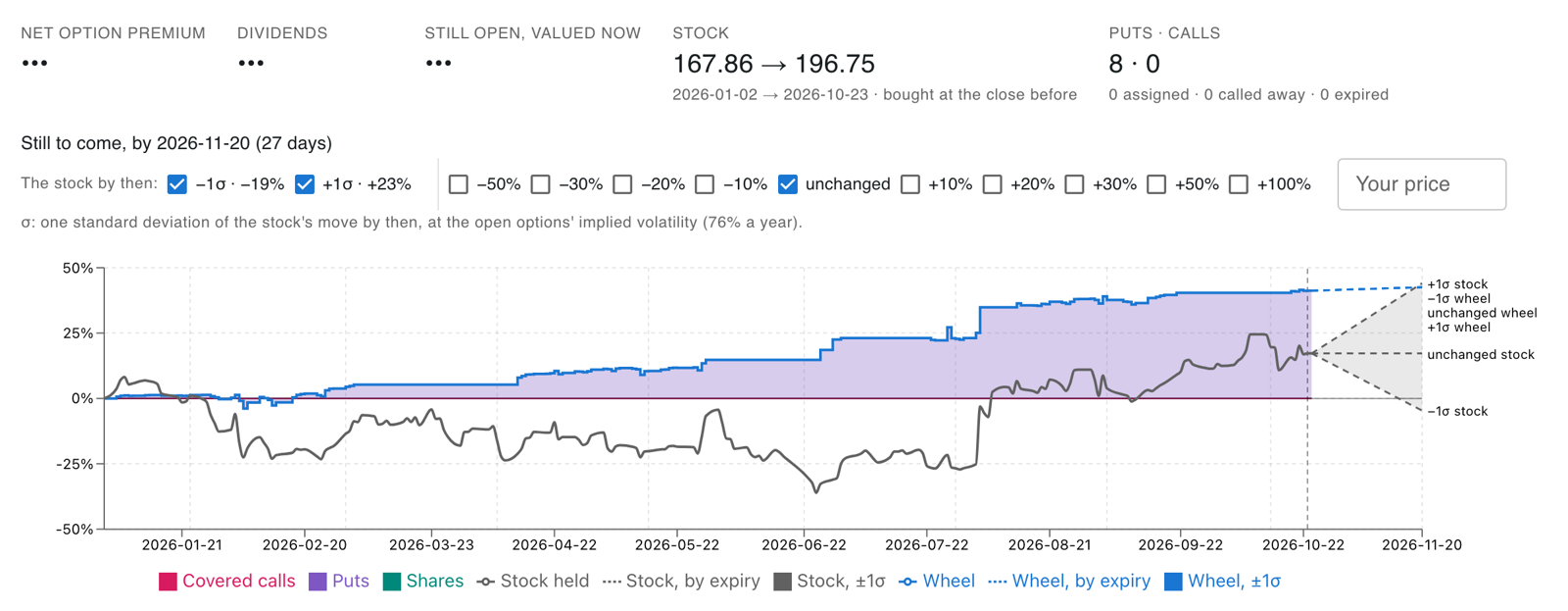 PLTR on OptionAgent's Wheel vs Stock page, for our connected brokerage account (privacy mode): the puts (purple) add a premium at every sale, while the stock spent most of the year below where it started, about 36% down at its low in June.
What the wheel is, and what it isn't
The wheel is not a way to avoid losses: if a stock falls 58%, you'll lose money owning it, just much less. And it isn't for the stock you expect to double next quarter: then you want the shares, without a call on top. It is a disciplined way to get into stocks you'd like to own anyway, get paid while you wait, and soften the drops that come with owning them.
Running the wheel in OptionAgent
In OptionAgent the wheel runs itself. The Getting started page takes you there in a few steps:
- Pick your names. Start from a starter list that matches your risk tolerance (Conservative, Neutral or Aggressive), untick any stock you wouldn't want to own, or add your own.
- Switch on automatic sales. OptionAgent then sells the puts on your names, manages them, sells covered calls on any shares you're assigned, and shows every wheel against simply holding the stock on the Wheel vs Stock page.
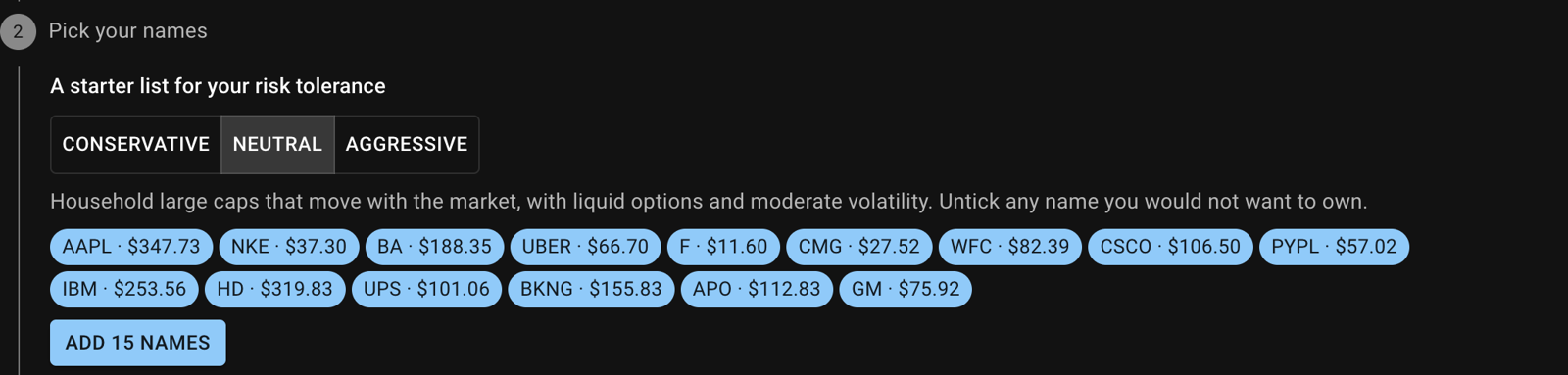 Step 2 of the Getting started page in OptionAgent, for our connected brokerage account: pick a starter list (here Neutral), untick any name, and add them.
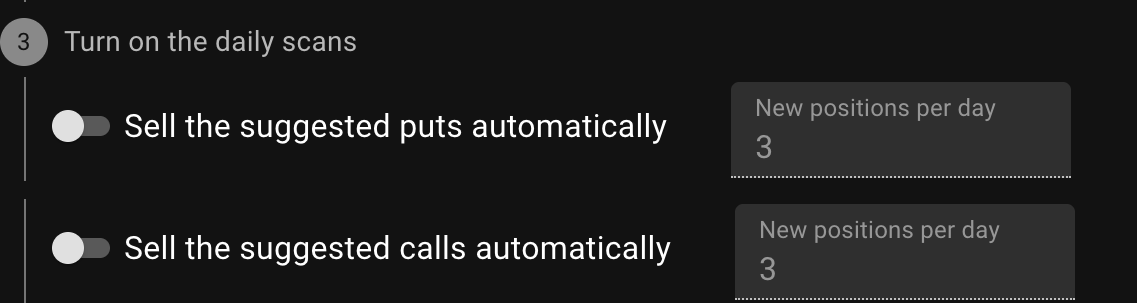 Step 3: one switch to sell the puts automatically, one for the covered calls.
The figures are from one OptionAgent trading account, 2026 through October 23, for the stocks it wheeled; each comparison holds the same stock from the day the wheel started, on the same capital. They describe what happened, not what will happen.